
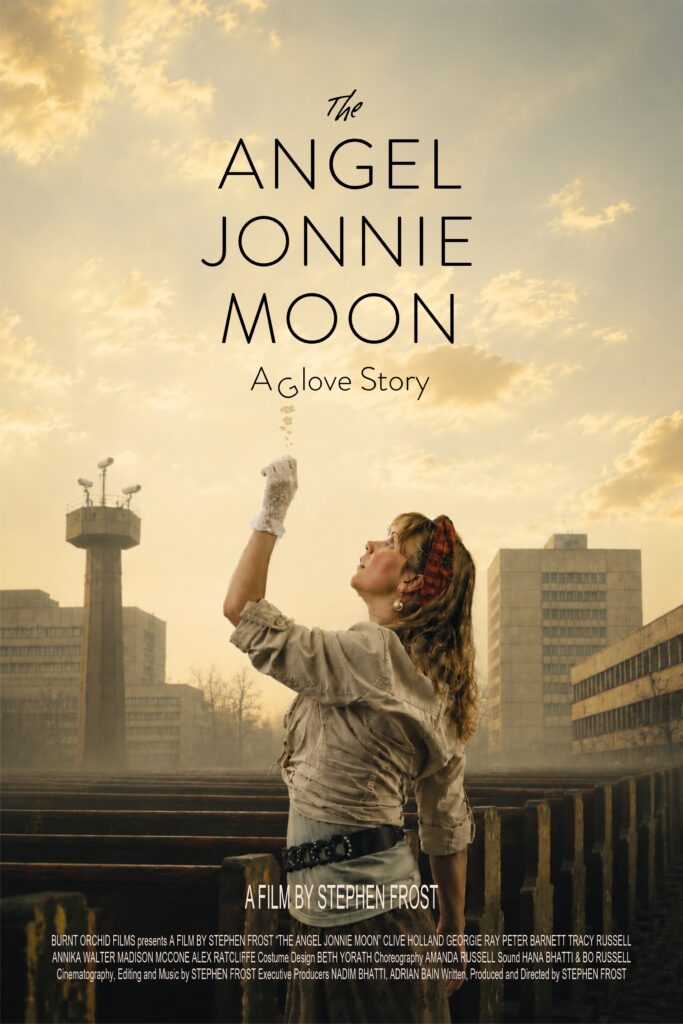
Let me introduce you to the new poster for my film “The Angel Jonnie Moon”. I hope you like it.
It has been created with the help of AI. In anticipation of any pushback, I thought I’d get my counter-arguments in first – and see if I agree with myself.
What was my input?
Firstly, let me outline what is and is not AI-generated. The central image of Jonnie Moon is a screenshot from the film, as are the church pews behind her. So in basic terms these components are not AI-generated, although the AI software has significantly posterised them by manipulating the contrast and saturation, and also probably by using other techniques I’m not aware of nor understand.
The typesetting is all mine. I chose the fonts, decided on their placement and invented the tagline as well as the idea of the dropped “G” in it. (I took this route because ChatGPT advised me to, saying AI was not particularly good at visually manipulating text. I thought this was very honest of it.) The tiny puffs of cloud that connect Jonnie Moon’s hand to the text were also inserted by me. I like the way she is breaking through the fourth wall, which resonates with the magical realism of the film and is an idea I’d like to think AI could not have conceptualised by itself, although that may be wishful thinking.
What was AI’s input?
Next, I entered prompts into the AI so it could build the poster around the still image. By definition, these prompts were mine – the dystopian communist-style background, the CCTV tower, the sky delivering a contrasting sense of hope, awareness of negative space – those were all my visual ideas, but the AI realised the graphics without any physical input from me. If you were being charitable you might describe it as a collaboration. (By the way, in a bizarre merry-go-round of circularity, I asked ChatGPT how to word my prompts to get the best results. In other words, how would it ask itself to do it?!)
I tapped enter and waited, without having particularly high hopes – I’ve played around with AI-generated graphics before with little success and have invariably given up. But fifteen seconds later the poster arrived and I sensed immediately this was worth exploring further. I spent a couple of hours on probably twenty iterations, tweaking my prompts in response to each previous version until I ended up with something I really liked. This, combined with my own typography, is the poster you see before you.
The result?
The first and obvious criticism is that it looks a bit AI-generated. Regardless of the quality and effectiveness of the artwork, this could in itself be a marketing problem. We have very quickly become tuned in to the signals this kind of content transmits – and we start clutching our pearls. Acceptance or rejection becomes purely ideological. My own feeling is that movie posters created by professional graphics artists actually have some of the same quality – a kind of fake hyper-realism that immediately catches the eye. This is why I actually like the end result here, in a way I might not in other contexts. Has AI done the job for me as well as a human professional would? I suspect not; so why not get that professional artist to design the poster for me in the first place?
Why not give the job to a professional?
I’m not a graphics artist, but I enjoy dabbling and I’m not terrible. I designed the poster for my previous film (this was over ten years ago and therefore without the help of AI) and it did the job well enough. Without the funding to pay an expert to do it for me, I did the best I could on my own and no one seemed to mind or to suggest I had put that expert out of a job. Do we throw someone on the dole queue if we don’t have the money to hire them in the first place? Does the job ever exist? I think it depends on which end of the telescope we look through.
In that sense, during the production of my film I put a lot of people out of work. Notwithstanding the significant help given to me by some amazingly talented people, it is nevertheless true that I did the cinematography and sound myself. I’m now editing and colour-grading the footage, as well as editing the dialogue and building the sound design. I’m also writing the music (the one thing I’m actually qualified to do). I’m not blowing my own trumpet here, nor claiming to be better at these roles than those experts who specialise in them, I’m just saying I’ve ‘put people out of work’ because of budgetary constraints (I have no money). Whether we like it or not, this has always been the way with low-budget independent film-making. Designing a movie poster comes with the same constraints, and thus the same one-man-band solutions.
Is using AI cheating?
What of morality? Maybe there’s simply a moral argument to be had for resisting AI in this context. I sometimes think cheating is the very definition of film-making. The sound of Fred Astaire’s tapping feet was overdubbed for good technical reasons, but it did mean his timing could be improved upon (it was); Marni Nixon dubbed the singing voices for Deborah Kerr, Natalie Wood, Audrey Hepburn and Marilyn Monroe amongst many others; Ridley Scott tells the story of using Harrison Ford’s body-double in silhouette for an entire scene because he couldn’t afford to get his star actor back to film it after the main shoot; Visual Effects are so powerful now that it’s hard to say whether anything is real; in my capacity as composer, I use sample libraries all the time, which means the sounds you hear – e.g. guitar, violin, flugle horn, choir – are not those real acoustic instruments or singers but samples played by me on a keyboard. Cheating? I guess so. Taking work away from real musicians? No doubt about it. There are different kinds of cheating but when it puts artists out of work that’s why we call it out, because it hurts real people. However, most of us still consume it and choose not to pull back the curtain, holding our guilt at arm’s length.
Is it stealing?
This is where I’m least clear in my own mind about what’s going on, but here’s my take on it, although my thinking is still in a state of flux. AI scoops up hundreds of petabytes of data scraped from the internet without anyone’s permission. The background image of my poster must be based on someone else’s artwork or photograph – or, much more likely, a conflation of the work of thousands of artists. But I do this all the time. Nothing I’ve ever created has fallen into my lap from the vacuum of outer space. Inspiration comes from all angles and all sources, consciously or subconsciously, by accident or design. “Inspired by”, “in reference to”, “a variation on”, “in homage to”, all euphemisms for taking someone’s idea and making it one’s own. I’ve sometimes written a piece of music that turns out to be by another composer because I heard it ten years ago and then forgot it. Truly original thought is rare and elusive. We can’t all be Ennio Morricone. I’m sure AI does not generate ideas in the same way the human mind does, but it does get its source material from the same place.
Is it any good?
I’ve had enough feedback to gauge the poster’s merits and failings, and it definitely works as far as it goes. But this is not a discussion about whether the poster is actually any good. That’s for another time. I find I’ve written more, here in this article, than I expected about the use of AI in my poster’s creation, perhaps out of guilt. Methinks the gentleman doth protest too much? It’s complicated, morally grey. Let’s not forget, some professional graphics artists use AI themselves. It may improve their chances of getting work, or doing it faster, or better – helping them to survive in a tough business. All I can say is my project is on a journey, and if I get funding to have the poster professionally designed, we’ll find out in which direction my moral compass is pointing then. A major distributor (should I be so lucky as to find one) may insist on it and change the design anyway. For now, it gets me from A to B, on my long journey to Z. It’s the best I can do, and I owe my best to the people who worked on my film and gave me theirs. As long as AI is my emissary, not my master, I expect I’ll continue to use it. As for the bigger picture of AI-generated content, the consumer will no doubt vote with their feet and their wallet – and their heart. Although personally I’m unclear what the wise path is, let’s hope they choose wisely.